By: Mahmoud Darwish
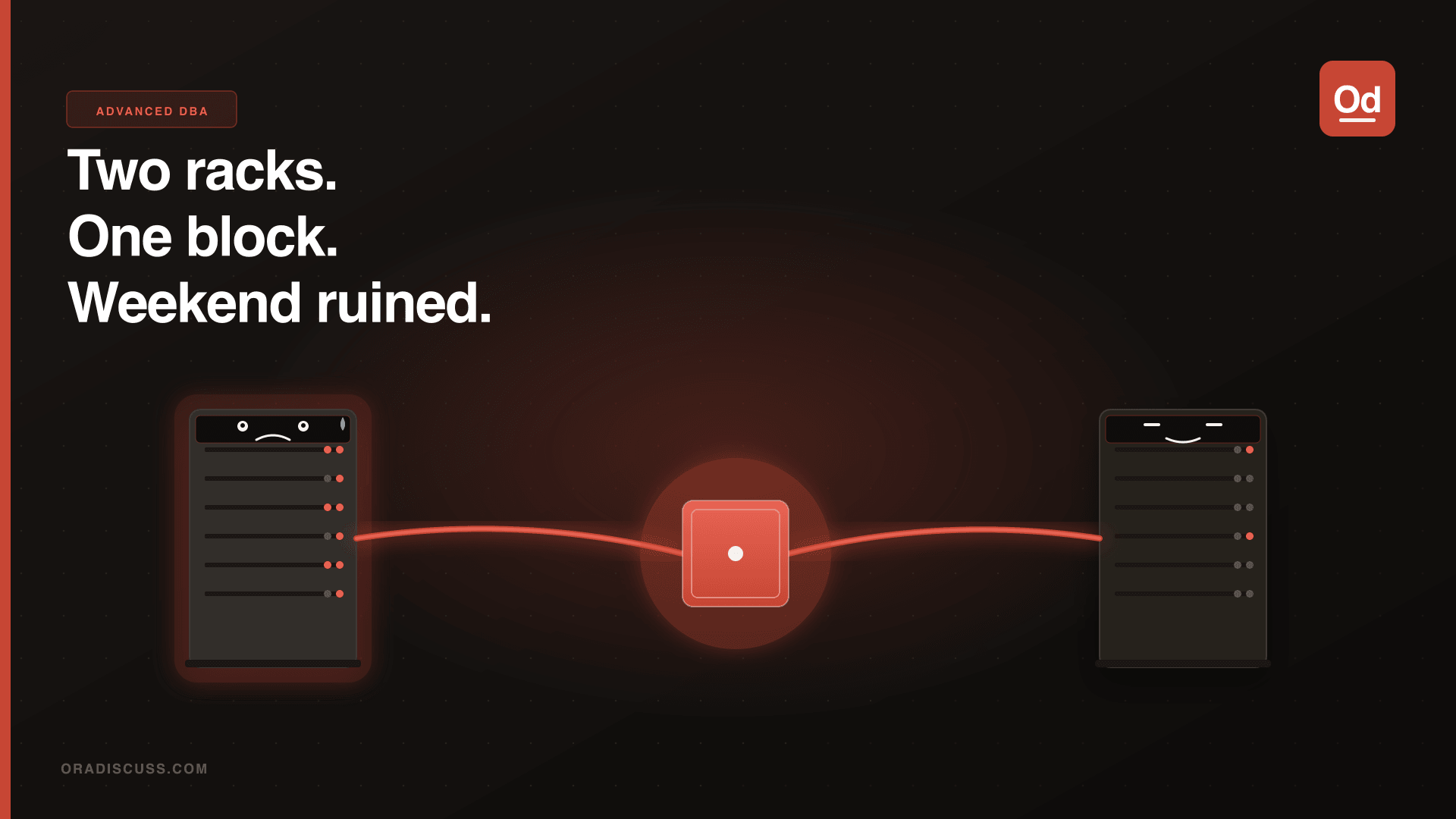
If you’ve spent any meaningful time managing Oracle RAC, you’ve developed a personal relationship with gc buffer busy acquired. Not a good relationship. The kind where you see the name in an AWR report and reach for your coffee.
The Setup
We run a 2-node RAC cluster for a financial processing system with a very specific access pattern: lots of small, targeted transactions hitting a relatively small set of “hot” rows — account balance tables, transaction status tables.
For months it ran fine. Then we upgraded the application, and suddenly response times for certain transaction types doubled. Not crashed, not errored out — just doubled. Which, in financial services, is enough to get people very upset very quickly.
What AWR Was Telling Me
The top wait event was gc buffer busy acquired with an average wait time around 15–20ms. In RAC, this means your session is trying to get a buffer that another session is in the process of transferring between nodes.
SELECT inst_id, event, total_waits,
       time_waited_micro / 1000000 AS time_waited_sec,
       average_wait
FROM   gv$system_event
WHERE  event LIKE 'gc buffer busy%'
ORDER BY time_waited_micro DESC;
Node 1 was the aggressor — it was generating the hot block requests. Node 2 was mostly the victim.
Drilling Down to the Hot Blocks
SELECT owner, object_name, object_type,
       SUM(CASE WHEN statistic_name = 'gc current blocks received'
           THEN value ELSE 0 END) AS current_blocks_received,
       SUM(CASE WHEN statistic_name = 'gc cr blocks received'
           THEN value ELSE 0 END) AS cr_blocks_received
FROM   gv$segment_statistics
WHERE  statistic_name IN (
         'gc current blocks received',
         'gc cr blocks received')
GROUP BY owner, object_name, object_type
ORDER BY current_blocks_received DESC
FETCH FIRST 10 ROWS ONLY;
One table came back as a clear outlier — our account balance table. Several “hot” rows that get updated by almost every transaction were sitting in just a handful of blocks, and every node was fighting over them constantly.
The Root Cause Was the Application Change
The developer had made an “optimisation” — they changed a query to use an index range scan on a status column. The problem: this index access pattern was now hitting the same small set of “active status” rows repeatedly, concentrating I/O on very few blocks.
The old code was scattering the I/O slightly more — and that slight scatter was actually better in a RAC context because it reduced per-block contention.
What We Fixed
Short term: We used DBMS_STATS to increase the number of hash partitions on the hot table’s status index. Reverse key indexes were not suitable here because we still needed range scans.
The real fix: We added a sequence-generated “shard key” to the hot rows, and the application was updated to distribute updates across a set of N “slots” for the same logical account balance. It reduced gc buffer busy wait time by about 85% within the first day.
Infrastructure side: We also reviewed gv$cluster_interconnects and found packet retransmits pointing to a firmware issue on one of the network cards. That got patched during the next maintenance window.
The Takeaway
gc buffer busy acquired is not an “Oracle RAC problem.” It’s an application design meeting a shared-everything architecture problem. Before you tune the database, understand what the application is actually doing to those blocks. And when a developer tells you an “optimisation” is making things worse in production — they’re usually not wrong.